 Highprime
2026-08-10 · Highprime blog
Six of India's ten biggest skincare brands lost money last year
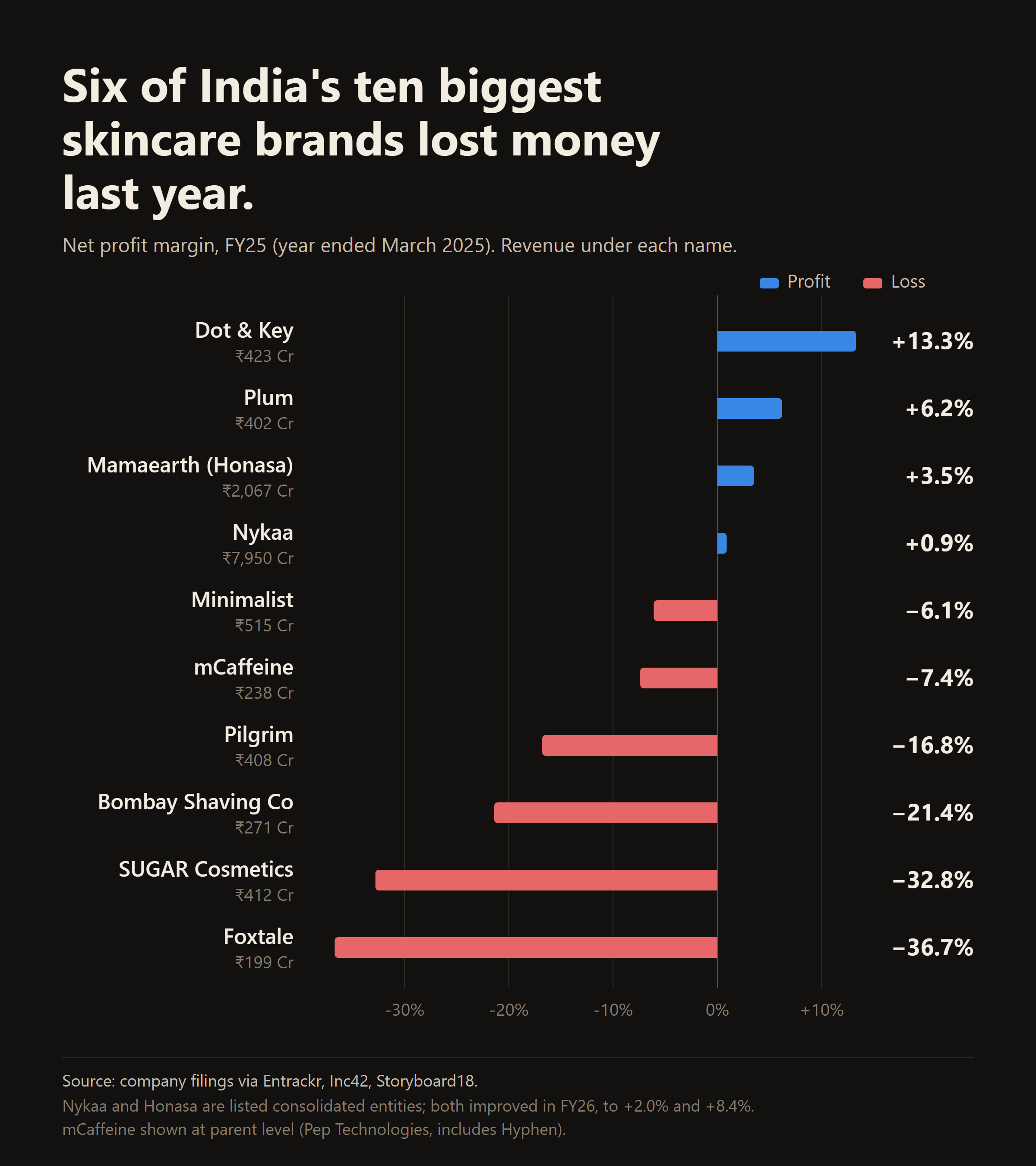
Nykaa kept 2 paise per rupee. Pilgrim put 57% of revenue into ads. I read the FY25 filings of India's ten biggest skincare brands. Six lost money.
A friend who runs a skincare brand told me last week that his company stopped being profitable somewhere in 2024. Not because sales fell. Sales grew. He just started losing money on the way to making them.
I didn't believe it was an industry-wide thing, so I went and read the filings. Ten of the biggest skincare and beauty brands in India, FY25, the year that ended in March 2025.
Six of them lost money.
What the filings actually say
Everything below is net profit margin. Not GMV, not ARR, not a funding round. What was left after every cost was paid.
| Brand | FY25 revenue | Net profit or loss | Margin |
|---|---|---|---|
| Dot & Key | ₹423 Cr | +₹56 Cr | +13.3% |
| Plum | ₹402 Cr | +₹25 Cr | +6.2% |
| Mamaearth (Honasa) | ₹2,067 Cr | +₹73 Cr | +3.5% |
| Nykaa | ₹7,950 Cr | +₹72 Cr | +0.9% |
| Minimalist | ₹515 Cr | −₹31.5 Cr | −6.1% |
| mCaffeine (Pep) | ₹238 Cr | −₹17.6 Cr | −7.4% |
| Pilgrim | ₹408 Cr | −₹68.7 Cr | −16.8% |
| Bombay Shaving Co | ₹271 Cr | −₹58 Cr | −21.4% |
| SUGAR Cosmetics | ₹412 Cr | −₹135 Cr | −32.8% |
| Foxtale | ₹199 Cr | −₹73 Cr | −36.7% |
Look at the shape of it. The best margin in the whole industry is 13.3%. The worst loss is 36.7%. The downside runs about three times deeper than the upside.
Nykaa is the one that stopped me. Nearly ₹8,000 crore of revenue in FY25 and it kept ₹72 crore. That is 0.9%. Under one paisa in the rupee. It did improve the year after, crossing ₹10,022 crore in FY26 and keeping about 2%, but two paise is still not a business anyone dreams about while writing a pitch deck.
Then there is Minimalist. It made ₹10.8 crore of profit in FY24. The next year it lost ₹31.5 crore, on revenue that grew 48%. HUL completed its acquisition of 90.5% of the parent company on 22 April 2025 for ₹2,706 crore. Worth being precise here, because plenty of people have the order wrong: FY25 ended on 31 March 2025, so that loss was already sitting in the books before HUL took control. They paid ₹2,706 crore for a brand whose economics had just broken.
So where does the money go?
Not into the product. That is the part that surprised me.
Foxtale spent ₹74 crore on raw materials to earn ₹199 crore of revenue. That is 37 paise per rupee, which means a gross margin of about 63%. Healthy. Normal for skincare.
It spent ₹106 crore on advertising in the same year.
More on ads than on the thing in the bottle.
Here is ad spend as a share of revenue for the year:
- Pilgrim: ₹234 crore of ads on ₹408 crore of revenue. 57%
- Foxtale: ₹106 crore on ₹199 crore. 53%
- Mamaearth: around a third of revenue
- Minimalist: 30%
Foxtale spent ₹1.40 to earn ₹1 in FY25. That was an improvement. The year before it was ₹1.67.
None of these brands lose money making the product. They lose it buying the customer. We once ran the same arithmetic on a single serum order, and it breaks in exactly the same place.
Ads have quietly got much more expensive
I run ad accounts for a living, so this next part is my own observation rather than something out of a filing. Over the last four years the cost of buying attention in this category has climbed steadily, and it has not stopped.
The reason is not complicated. Meta and Google don't set a price, they run an auction. Picture a hundred skincare brands going after the same woman searching for a niacinamide serum. Every one of them raises its bid to get in front of her.
One of them gets the sale.
The other ninety nine paid to be in the room and walked out with nothing. Multiply that across every impression, every day, and you get a ₹73 crore loss on ₹199 crore of revenue.
The auction is working exactly as designed. It is just that when a category gets crowded, the auction transfers the category's entire margin to the platform running it. Skincare has low entry barriers, high gross margins and near-identical products. It is the perfect category to get eaten this way.
And the customer doesn't stay
Only about 10% of Indian beauty buyers describe themselves as loyal to a brand. Around 72% keep trying whatever is new.
Sit with what that does to the maths above.
You win her once, at a price that already hurt. She tries you, quite likely likes you, and then buys something else next month because a different brand was running an offer. So you go back into the same auction and pay again to win back a customer you already had.
That is a business model where you rent your customers by the month and never get to own them.
Four brands made money. Here is how.
Dot & Key had the best margin in the group at 13.3%, and it did that while growing 113%. Its sales split is 70% marketplaces, 20% own website, 10% offline. It ranks #1 in sunscreen, #2 in moisturisers and #3 in face wash.
That ranking is the whole trick. When you are the top result in a category on Amazon, Nykaa or Blinkit, the platform's own traffic finds you. Rank does the job that ad spend does for everyone else. Worth adding one honest caveat: Nykaa owns 90% of Dot & Key and also owns 237 stores it sells through, so its parent company is its shelf. No independent brand can copy that part.
Plum is the cleaner example, and its number is the one I would tattoo on a wall. In FY24 it lost ₹84 crore. In FY25 it made ₹25 crore.
It got there by spending less on ads. ₹139 crore in FY25, down 7% from the year before, while revenue grew 23% to ₹402 crore. Ad spend went from roughly 46% of revenue to about 35%.
Where did the demand come from instead? A shelf. Plum sells through more than 1,500 physical stores, split roughly 60% online and 40% offline, built up patiently since it entered multi-brand outlets in 2017. A shelf is demand you own. You pay for it once and people walk past it every day after that. Stop paying Meta and you vanish the same afternoon.
Worth noting the swing was bigger than ad discipline alone can explain, so FY24 almost certainly carried some one-off charges. But the direction is not in doubt.
The contrast that makes the point is SUGAR. It also expanded offline, and it posted the second-worst loss on the list at −32.8%. The visible difference is pace. Plum compounded into retail over eight years. SUGAR bought its way in fast.
And then there is Moxie Beauty, in haircare rather than skincare, which crossed ₹100 crore of ARR in two years with a repeat rate above 40%. Four times the category's loyalty rate. It gave people a reason to come back on their own instead of outbidding anyone for them.
What this actually means
The Indian skincare market is growing. That part is true and everyone says it. What nobody puts on a slide is that the growth is being bought, and the receipts are public.
Three brands escaped, three different ways. Dot & Key through category rank. Plum through physical shelf and an owned customer list. Moxie through a product people return to without being chased.
One thing joins them. None of them rent their demand.
If you are building here, that is the question to answer before you write a single ad. Why would she come back on her own?
If there is no answer yet, more ad budget will not create one. It will just move your margin to an auction.
If you are weighing up entering this category, the follow-up to this piece is worth reading: should you start a skincare brand in India, which breaks down the manufacturer's maths and the costs that never make it into the pitch. And if you have decided to build anyway, here is how to do it without repeating what the filings above describe.
Questions people ask about this
Are Indian skincare brands profitable?
Mostly not. Of the ten biggest skincare and beauty brands in India, six lost money in FY25. The four that made money were Dot & Key at +13.3%, Plum at +6.2%, Mamaearth's parent Honasa at +3.5% and Nykaa at +0.9%.
How much do Indian skincare brands spend on advertising?
Between 30% and 57% of revenue. Pilgrim spent ₹234 crore of ads against ₹408 crore of revenue in FY25, which is 57%. Foxtale spent 53%, Mamaearth around a third, and Minimalist 30%.
Which Indian skincare brands made a profit in FY25?
Four. Dot & Key made ₹56 crore on ₹423 crore of revenue. Plum made ₹25 crore on ₹402 crore. Honasa made ₹73 crore on ₹2,067 crore. Nykaa made ₹72 crore on ₹7,950 crore.
Why are D2C skincare brands losing money if gross margins are good?
Because the losses happen after the sale, not during it. Foxtale's raw materials were only 37 paise per rupee of revenue, so its gross margin was around 63%. It then spent more on advertising than on the product itself. Customer acquisition, not manufacturing, is what turns a healthy gross margin into a net loss.
Did HUL's acquisition make Minimalist unprofitable?
No. Minimalist's ₹31.5 crore loss was in FY25, which ended on 31 March 2025. HUL completed its acquisition on 22 April 2025, after that year had closed. The brand had already swung from a ₹10.8 crore profit in FY24 to a loss before HUL took control.
Sources
Every figure above comes from company filings as reported by the following. Worth reading in full if you want the detail.
- Foxtale FY25 revenue and losses, Entrackr
- Minimalist FY25 revenue and net loss, Entrackr
- Plum FY25 turnaround and expense breakdown, Entrackr
- Pep Technologies and mCaffeine FY25, Entrackr
- Honasa FY26 results, Entrackr
- Pilgrim crosses ₹400 Cr in FY25, Inc42
- How Dot & Key scaled and turned profitable, Inc42
- HUL completes its 90.5% acquisition of Minimalist, Inc42
- SUGAR Cosmetics FY25 revenue decline, Storyboard18
- HUL's Minimalist bet and D2C profit pain, Storyboard18
- Dot & Key FY25 revenue and profit, Startuppedia
- Bombay Shaving Company FY25, Startuppedia
- Nykaa crosses $1 Bn revenue in FY26, Indian Retailer
- Moxie Beauty raises $15 Mn, Indian Retailer
- Why beauty brands keep shutting down, The Established