 Highprime
2026-08-14 · Highprime blog
How to start a skincare brand in India the right way
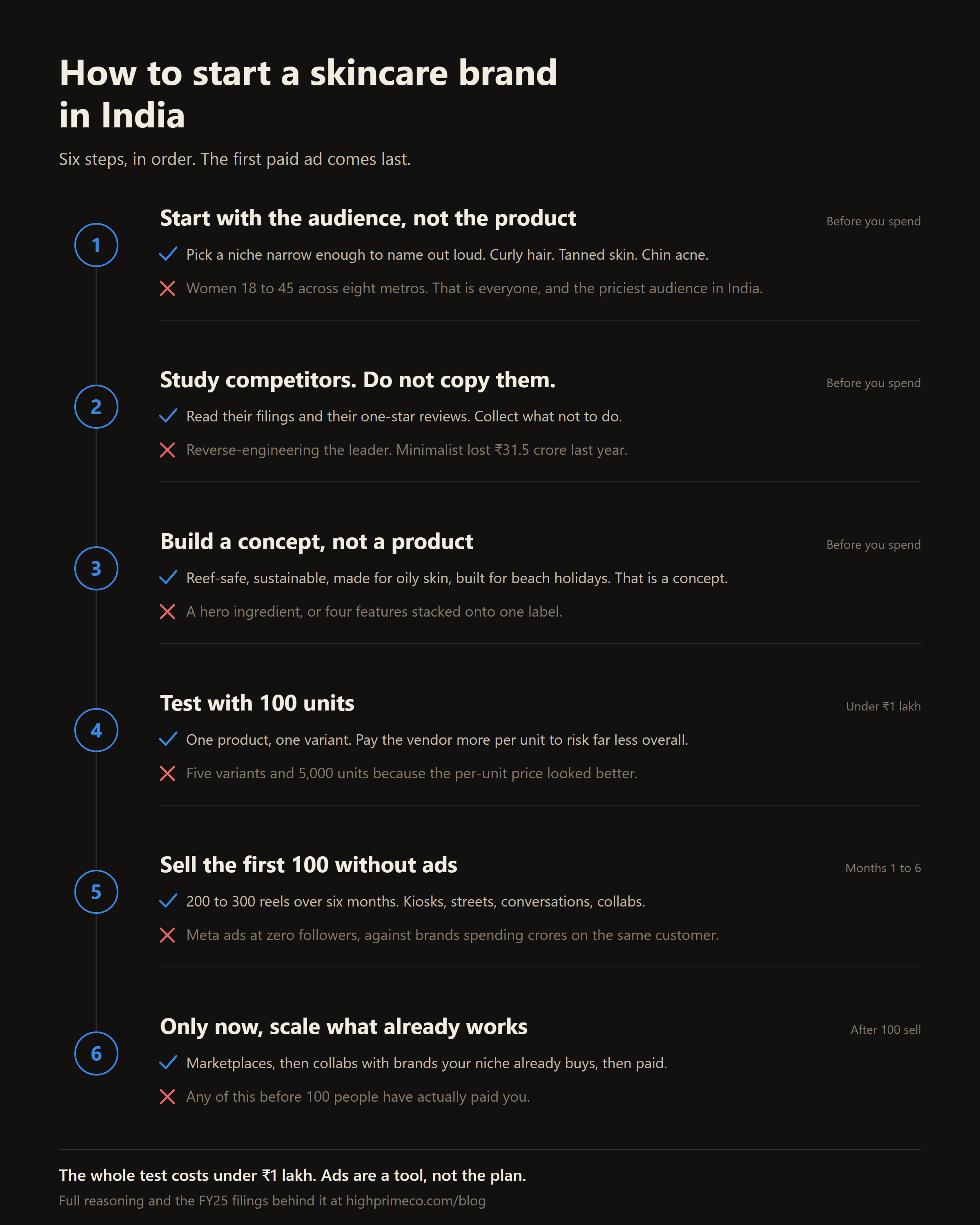
Six steps for entering India's skincare market without burning money. Find a niche, build a concept, test 100 units, and sell them before you touch an ad.
In my last piece I said something blunt: do not start a skincare brand as your first business. I still mean it.
But I ended that one by saying there is a different conversation to be had, if you already know the customer and have a reason people would come back without being chased by an ad.
This is that conversation. Everything below is what "knowing the customer" and "a reason to come back" actually look like when you sit down and do them.
First, stop reverse-engineering the winners
Most advice starts the same way. Find a successful brand, take it apart, copy the blueprint.
Studying competitors is a fine starting point. Copying them is not, and here is the specific reason why.
You would look at Minimalist and think that is a leading Indian skincare brand, so copy it. Except Minimalist lost ₹31.5 crore in FY25. Six of the ten biggest brands in the country lost money that year. Reverse-engineer a loss-making company carefully enough and you will arrive, precisely and on schedule, at a loss-making company.
The blueprint you are copying has to actually work first. Almost nobody checks.
So here is the order I would go in.
Step 1: Start with the audience, not the product
Pick the people before you pick the thing you sell them.
And pick a narrow group. Not because narrow is virtuous, but because broad is expensive. Look at what almost every skincare brand in India is targeting right now: women, 18 to 45, in Mumbai, Delhi, Bengaluru, Chennai, Hyderabad, Kolkata, Pune and Ahmedabad.
That is most of urban India, not a target audience. Every brand with a bigger budget than yours is bidding on those same people, which is why the auction eats everyone who shows up to it.
Go deeper instead. Is this woman's hair curly? Is tanning her actual daily problem? Does she get breakouts specifically along her chin? Ask around on that last one, it is a real and fairly common complaint. I am not telling you to go and build a chin acne brand. I am showing you how far down you can usefully go before you stop.
This cuts both ways on pricing too, because a discount changes who shows up, not just what you earn. The narrower you go, the more personal the product feels, and the cheaper it is to reach the person who wants it.
Step 2: Study competitors properly, which means studying their failures
Now go back to the competitors, but look at the right things.
Pull their filings. Read the actual numbers rather than the press release, because the headline is almost always revenue and almost never profit. If you can find month-on-month revenue, find the months where they underperformed and work out what they were doing in those months.
Then go where the honest information is.
Read the one and two-star reviews. Those tell you what people do not want, which is far more actionable than what they say they like. Look for the problems your competitor is not solving for the audience you picked in step 1. Look at their collaborations that went nowhere. Then go through their failed ads, the ones that ran briefly and disappeared. Failures carry a pattern and that pattern is usually easy to uncover.
Failed ads are also where a brand was genuinely trying something. Most of the time brands copy whatever is working for a competitor, which is how a whole category ends up with the same formats, the same colours and the same message until all of it is saturated. The ads that flopped are often the ones where somebody attempted something new. You get two things from them: what has already been tried, and how stale the safe option has become.
A pattern shows up quickly. That pattern is worth more than any teardown of what the market leader gets right, because it gives you hard limits: a list of things you now know not to do.
Step 3: Build a concept, not a product
The ingredient is not the hero
A trendy ingredient is not a product. A moisturiser with an ingredient that hydrates skin and allegedly fixes your relationships is still just a moisturiser.
Combining features does not help either. "Hydrates and clears acne" reads like value, except four hundred other products say the same thing. Look at what already sits on any shelf. The serum fights acne, the moisturiser hydrates, the cleanser handles marks, the toner hydrates again. Every combination is covered, so bolting two of them together adds nothing that was not available yesterday.
Nobody remembers a feature list. They remember a product that was obviously made for them, and that is what a concept gives you.
What a concept actually looks like
A feature sounds like this: this sunscreen has sustainable packaging. Useful, and roughly forty other brands say it.
A concept sounds like this: this sunscreen has sustainable packaging, is non-toxic to marine life, uses natural ingredients and is made for oily skin, so it is the one you take on a beach holiday. The concept is sustainability. The niche is people going to the beach. Now the product has a reason to exist and a moment it belongs to.
Products built for everyone tend to win offline, in tier 2 and tier 3, on shelves, on price and distribution. Your online buyer in a tier 1 city is asking a different question entirely: is this for me, or is this for everyone? If the answer is everyone, they scroll.
Virality comes from concepts, not features. "Korean products for glass skin" is a concept. Glass skin is the thing being sold, not the ingredient list.
The best current Indian example is Moxie Beauty. The niche is wavy, curly and frizzy hair. The concept is a complete routine rather than a bottle: a three and four step system, cleanse, condition, lock and style, that guides people through the curly girl and wavy girl method without needing to research it.
And here is the part that ties back to everything I wrote last time. Moxie's founder, Nikita Khanna, spent years heat-straightening her own wavy hair to make it look neat and tidy. She stopped during the 2020 lockdown, rediscovered her natural texture, and then spent two years on formulations built for Indian hair and Indian water before launching in November 2023.
She was the customer. That is why the concept is precise, and it is the exact opposite of starting a brand off a manufacturer's price list for a customer you have never been.
Step 4: Test with 100 units, not 5,000
You have a concept. Now find a vendor, and ask for something they will not want to give you: a run of 100 to 500 units.
Nine out of ten manufacturers will say no. Push anyway. Offer to pay more per unit. You are trying to spend ₹10,000 to ₹20,000 to find out whether anyone wants this, and paying a premium per bottle is a bargain compared to the alternative.
The alternative is what most people do. The vendor offers 50% off per unit at 5,000 units, the maths looks great, you spend ₹9 lakh, and then you find out the concept was wrong. Now you have nine lakh rupees of serum sitting in a room and no one to sell it to.
Haggle for the best value at the smallest possible commitment. That is the entire skill at this stage.
And do not launch five variants. Five variants splits your marketing, your budget, your attention and your data five ways, at the exact moment when you need a clean signal about one thing. You are testing whether the concept works. One concept, one product, one variant, 100 units.
One product. One variant. 100 units. One website. One product page. The whole test comes in under a lakh. If you are three friends splitting it, that is a small amount each, though I would think hard about the three friends part before the money part.
Now go sell them.
Step 5: Sell the first 100 without spending on ads
This is the step people argue with, so let me be precise about what I am saying.
I run ad accounts for a living. Ads are a tool. Marketing is the whole thing, and content is marketing, conversations are marketing, a kiosk on a street is marketing. Ads are one instrument in that, not the plan itself. Reaching for them first is what the entire loss-making half of this industry did.
Think about what you are walking into. The ten biggest skincare brands in India are spending crores to reach exactly your customer. Pilgrim put 57 paise of every rupee of revenue into ads. You arrive with ₹1,000 a day and zero followers. That money goes straight to Meta and brings back close to nothing.
So spend the first six months differently.
Make content, and make a lot of it. Aim for 200 to 300 pieces in six months, reels in particular, and somewhere between 2,000 and 10,000 followers. Earn them. Buying followers through Meta poisons the account and the algorithm does not forget them. Go out on the street and talk to people. Set up a kiosk. Sell at markets and events. Do collaborations. Get a Meta Verified badge if it helps you look legitimate, which currently runs about ₹1,099 a month on the web or ₹1,450 in-app, and looking legitimate matters more than most founders admit.
Do not spend a rupee on ads until you know which content works. The rule we work by is under a 30% profit margin, paid acquisition is not your tool yet.
After two or three hundred pieces of content you will have something no ad budget can buy: a content blueprint. You will know which hooks land, which format holds attention, which claim makes someone stop, which objection keeps coming up. Then you double down on what works, and only then does paid make sense, because now you are amplifying something proven instead of paying to discover it. When you get there and want help, we compared what seven performance marketing agencies for D2C brands publish, fees included, in the best performance marketing agencies in India for D2C brands.
Yes, this takes six months to a year. Yes, it is slow and unglamorous. These are the roots of marketing from before the digital era, and they still work, which is more than can be said for a cold ad account in the most expensive auction in Indian D2C.
Step 6: Only now, scale what already works
Once 100 people have paid you, you know the concept works. That is worth more than any amount of planning was.
Now go wider. List on Nykaa, Amazon, Myntra, Flipkart, Meesho, wherever your specific audience actually shops. Marketplace rank does work that ad spend does everywhere else, and it is the single biggest reason Dot & Key is profitable while most of its competitors are not.
Then collaborate with brands your niche already buys from, and run the milestone-number math before you sign anything. Take the sustainable beach sunscreen: partner with a travel brand, a hostel chain, a swimwear label, and give the product free to the first hundred people who register on your site. You are after awareness, credibility and access to an audience somebody else has already gathered, made up of exactly the customer you defined in step 1. The sales are a bonus.
That is the sequence. Audience, then positioning, then research, then concept, then a small test, then proof, then scale.
Most brands run it backwards, start with a trending formulation and an ad account, and end up in a filing like the ones I have been reading all month.
Questions people ask about starting a skincare brand
How do I start a skincare brand in India with low investment?
Test one concept before scaling. One product, one variant, a manufacturing run of 100 to 500 units at ₹10,000 to ₹20,000, one website with a single product page. The whole test comes in under ₹1 lakh, and you sell those first units through content and offline channels rather than paid ads.
Should I run Meta ads when launching a skincare brand?
Not at the start. India's biggest skincare brands spend crores targeting the same customers, with Pilgrim putting 57% of revenue into advertising in FY25. A new brand with a small daily budget and no followers cannot compete in that auction. Build a content blueprint over 200 to 300 pieces of content across roughly six months first, then use paid to amplify what already works.
How many units should I order from a skincare manufacturer first?
Between 100 and 500. Most manufacturers push much higher minimums and will offer a far better per-unit price at 5,000 units, but paying more per unit on a small run costs a fraction of what unsold inventory costs if the concept is wrong.
What is the difference between a USP and a concept in skincare?
A USP is a feature, such as sustainable packaging. A concept combines features into an identity for a specific person and moment, such as a reef-safe sunscreen made for oily skin and built for beach holidays. Concepts travel and features do not, which is why concept-led brands go viral and feature-led ones compete on price.
Why should I not copy a successful skincare brand's strategy?
Because most of them lose money. Six of India's ten biggest skincare brands were unprofitable in FY25, including Minimalist, which lost ₹31.5 crore. Copying a brand's playbook without checking its filings means copying the route to its losses as well as its growth.
Sources
- Six of India's ten biggest skincare brands lost money last year, our FY25 analysis of the filings
- Should you start a skincare brand in India?, the economics behind this piece
- Minimalist FY25 revenue and net loss, Entrackr
- Pilgrim crosses ₹400 Cr revenue in FY25, Inc42
- How Dot & Key scaled and turned profitable, Inc42
- How Moxie Beauty built a curl-first brand in India, Flypup
- Fireside Ventures on backing Moxie Beauty, Fireside Ventures
- Meta Verified pricing in India, Outlook Business
- Red ocean versus blue ocean strategy, Blue Ocean Strategy