 Highprime
2026-08-11 · Highprime blog
Should you start a skincare brand in India? What the numbers say
Most Indian skincare brands lose money. So why does a new one launch every week? The revenue PR, the manufacturer's maths, and the costs nobody mentions.
Skincare in India is a brutally competitive market. Most of the companies in it lose money. I went through the FY25 filings of the ten biggest brands recently and six of them were in the red, which is worth a read before this one because it is the evidence underneath everything below.
So here is the question that actually interests me.
If the market forces are this obvious, why does a new skincare brand launch practically every week? Why do first-time founders look at this and see a great opportunity?
I think I have the answer. Three of them, really.
1. The headlines talk about revenue, never profit
You have seen the format. "Mr Doe's skincare brand hits ₹300 crore in FY25."
What that sentence never tells you is whether the company made a single rupee. You can do ₹1,000 crore in revenue and end the year poorer than you started. Revenue tells you how much market you touched. Profit tells you whether you have a business. They are not the same thing and the press release is built to blur them.
It gets worse, because the number in the headline is often not even revenue. A lot of these announcements quote GMV, the total value of orders placed. For Indian D2C brands, net revenue typically lands at 55% to 70% of GMV once you take out discounts, returns and cancellations. So the figure a founder reads can be close to double what the company actually collected.
A founder sees ₹300 crore, does some quick maths, and thinks that even 10% of that market would change his life.
My favourite example of how fast this flips is Minimalist. It made ₹10.8 crore of profit in FY24 and got written up everywhere as the D2C brand that had cracked profitability. The very next year it posted a ₹31.5 crore loss. Same brand, same founders, same press cycle, opposite reality. If you had read the FY24 coverage and started a brand on the strength of it, you would have been copying a company that was already breaking.
Investors caught on before founders did. Brands doing over ₹100 crore of GMV struggled to raise their next round, acquisitions collapsed in due diligence, and valuations were cut by 50 to 70%.
2. "It's easy money," says the person selling you the product
I asked the founder of a loss-making skincare brand why he even started, knowing this is a red ocean, a market so crowded that everyone is competing on the same terms until the margin is gone.
His answer: "Honestly Sid, my manufacturer said it's trending and most big brands are buying this from him."
That is the standard origin story, not one founder's mistake. A third-party manufacturer shows you a formulation that is a near copy of everything else on the shelf, with one hero ingredient swapped in and space for your branding. It is trending. Big brands are buying it. The cost is around ₹52 a unit for the formulation itself, and often much less.
And the maths does look incredible. Sell that at ₹300 and you are keeping ₹248.
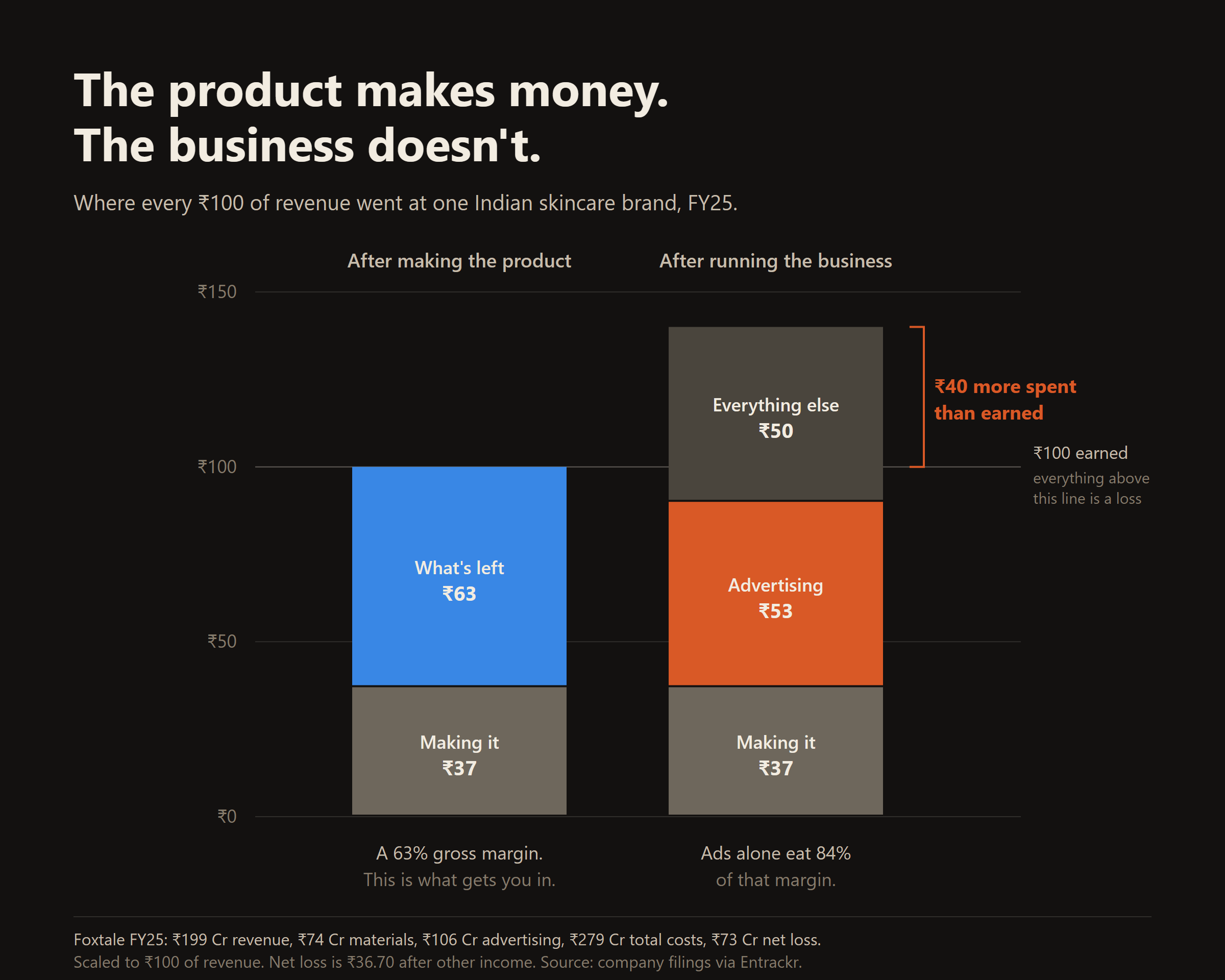
This is the part where the trap closes, so look at the chart at the top of this page.
Those are the real FY25 numbers from Foxtale, scaled down to every ₹100 the company earned. Making the product cost ₹37. That is a 63% gross margin, and it is completely genuine. Skincare really does have margins like that. Indian D2C beauty commonly runs 48% to 74%. This is the number that gets founders in the door, and nobody is lying about it.
Then advertising took ₹53.
Ads alone ate 84% of everything the product earned. Add salaries and the rest of running a company and total costs reached ₹140 against ₹100 of revenue. Foxtale finished FY25 with a ₹73 crore loss on ₹199 crore of revenue.
Pilgrim did the same thing at a bigger scale, putting ₹234 crore of ads against ₹408 crore of revenue. That is 57 paise of every rupee.
Notice who is fine in all of this. The manufacturer booked their margin the day your order shipped. Meta and Google collected on every impression whether or not anyone bought. Neither of them carried a rupee of your risk. The brand is the only party in the chain that gets paid last and loses first.
One correction worth making, since founders quote the per-unit number at each other constantly. That ₹26 to ₹52 figure is the formulation, the stuff in the bottle. Once you add the bottle, the pump, the carton and the label, landed cost is commonly ₹90 to ₹220. Packaging is often half your unit cost in this category, and it is the line new founders forget.
3. "We can sell to women"
This one is going to be uncomfortable, so stay with me.
Almost all skincare advertising in India targets women aged 18 to 45 in metro cities. That is where the budget goes. Which means men, as a group, are not being hyper-bombarded with skincare ads the way women are.
So think about what a man's entire exposure to this category consists of. Not the ads. Not the switching, the reviews, the ingredient debates, the disappointment of a product that did nothing after six weeks. He gets one thing: the revenue headline. "Mr Doe's skincare brand hits ₹300 crore."
He thinks, that looks like easy money, let me find a manufacturer.
The manufacturer then plays the card that closes it. You buy at ₹52, you sell at ₹300.
And another skincare brand is born, founded by somebody who has never once been the customer. He has never felt the thing that makes a person stay with a brand, because he has never been on the receiving end of the category. He is entering a spreadsheet rather than a market.
That is the actual problem, and it has nothing to do with capability. You can build a brilliant business for a customer you are not. But you cannot do it on a manufacturer's price list and a headline, and that is genuinely all a lot of these launches are built on.
Why founders keep starting skincare brands anyway
Put the three together and the pattern is obvious.
The headline overstates the prize. The manufacturer understates the cost. And the person doing the maths has usually never used the product.
None of that requires anyone to be stupid. Every input a first-time founder receives is telling them the same encouraging thing, and the one number that would change their mind, net profit, is the hardest to find and the least reported.
The bit nobody puts in the pitch
Say you go ahead anyway. Here is what is waiting.
There is no loyalty to win. Only about 10% of Indian beauty buyers describe themselves as loyal to a brand. Around 72% keep trying whatever is new. You are in a buyer's market where your customer is actively looking for something cheaper and better than you, permanently.
Claims cost money and return nothing. Every phrase you want on the label has a bill attached. Dermatologically tested runs around ₹15,000 per sample. Once you are testing a full range with in-vivo and in-vitro work and efficacy claims behind it, you are looking at ₹2 to 5 lakh. None of that spend brings in a single order. It only stops you being called out for the ones you make.
The auction gets more expensive every year. I run ad accounts for a living, and the cost of buying attention in this category has climbed steadily over the last four years with no sign of stopping. Every new brand that launches bids against you for the same customer. We have a rule about this: under a 30% profit margin, paid acquisition is not your tool yet. Your competition includes the brands starting this month, not only the ones that already exist.
So I will be blunt, which is the whole reason I wrote this.
Do not start a skincare brand as your first business. The sleepless nights, the thin margins and the constant stress are not worth it when you already know you are walking into a buyer's market with no loyalty and an auction that eats your gross margin.
If you have done this before, know the customer, and have a reason people would come back without an ad, that is a different conversation entirely. The brands that make money in this category all have that one thing. I have written that conversation up separately: how to start a skincare brand in India the right way, six steps that put the first paid ad last.
But if the plan is a trending formulation, a nice bottle and a Meta budget, the numbers above are what happens next. They are not predictions. They are filings.
Questions people ask before starting a skincare brand
Is a skincare business profitable in India?
Usually not. Of the ten biggest skincare and beauty brands in India, six lost money in FY25. Gross margins are strong at around 48% to 74%, but advertising costs commonly consume 30% to 57% of revenue, which turns a healthy gross margin into a net loss.
How much does it cost to start a skincare brand in India?
Beyond stock, budget for packaging, which is often half your unit cost, and for claim testing. Dermatologically tested certification is around ₹15,000 per sample, and a full range with in-vivo, in-vitro and efficacy studies runs ₹2 to 5 lakh. The largest cost by far is customer acquisition, which is an ongoing cost rather than a setup one.
How much do skincare manufacturers charge per unit in India?
The formulation alone commonly costs ₹26 to ₹52 a unit at reasonable order quantities. Landed cost including the bottle, pump, carton and label typically runs ₹90 to ₹220 a unit depending on format and order size.
Why do skincare brands lose money if the margins are so high?
Because the loss happens after the sale, not during it. Foxtale had a 63% gross margin in FY25 and still lost ₹73 crore, because advertising took ₹53 of every ₹100 of revenue. High gross margin attracts competition, competition raises the ad auction, and the auction takes the margin.
What is a red ocean market?
A red ocean is a market where the boundaries and the rules are already set, competitors are many, and everyone competes on the same terms until margins are gone. The term comes from Blue Ocean Strategy by W. Chan Kim and Renée Mauborgne. Indian skincare is a textbook example.
Sources
- Six of India's ten biggest skincare brands lost money last year, our FY25 analysis of the filings
- Foxtale FY25 revenue, advertising spend and losses, Entrackr
- Minimalist FY25 revenue and net loss, Entrackr
- Pilgrim crosses ₹400 Cr revenue in FY25, Inc42
- Why D2C valuation has moved beyond GMV, MyValuation
- India's D2C journey and the shift to discipline, Forbes India
- Cosmetic brand profit margin breakdown in India, TYMK
- Cost breakdown of personal care manufacturing in India, Naturo & Orgo
- Dermatologically tested service pricing, IndiaMART
- Red ocean versus blue ocean strategy, Blue Ocean Strategy
- Why beauty brands keep shutting down, The Established